The Gods come alive every year during Dussehra in all colours and shapes. Or that’s how I see it, in any case. Made of clay, coloured and decked in gold and glossy paint, these dolls of Gods flood the market for two weeks every year — a week before Dussehra, to the end of the festival. They come all the way from Maharashtra, Coimbatore and Puducherry to traditional markets like Mylapore, Malleshwaram, Jayanagar and a few more.
Tamil mamis and Telugu pinnis come in huge numbers to these stores with their girl pals checking out the new collection. Then there are the clueless husbands standing in the corner as their wives battle their way into the shops and emerge victorious with dolls of their choice. As the selection starts, a bargain battle unfolds between the doll seller and the ladies.

The dancers set.
Do you know I bought my first Meenakshi Amman for Rs.10 ? “, goes the slow moving grandma as she elbows me to get to the front. She takes a “Marapacchi Bommai” set and admires it as her childhood memories light up her eyes. ‘My mom gave me a small Marapacchi Bommai when I got married. I was just seventeen, she said. She opened up to me as apparently I posed no threat to her shopping. “That was my first doll in my Navarathri Bommai. I moved in to my in-law’s house in Kembanur (near Coimbatore) with just these dolls, and my Vinayagar photo frame which was given as a gift for my marriage. I still have it safe you know. Two generations have passed, but I still hold on to the Marapachi Bommai. Nothing these days looks as nice as the once I have, and is not even made of real red sandalwood”. Her daughter picks up a dancing doll and they are off to the next shop for return gifts, counting the number of guests and planning the rest of the festival.
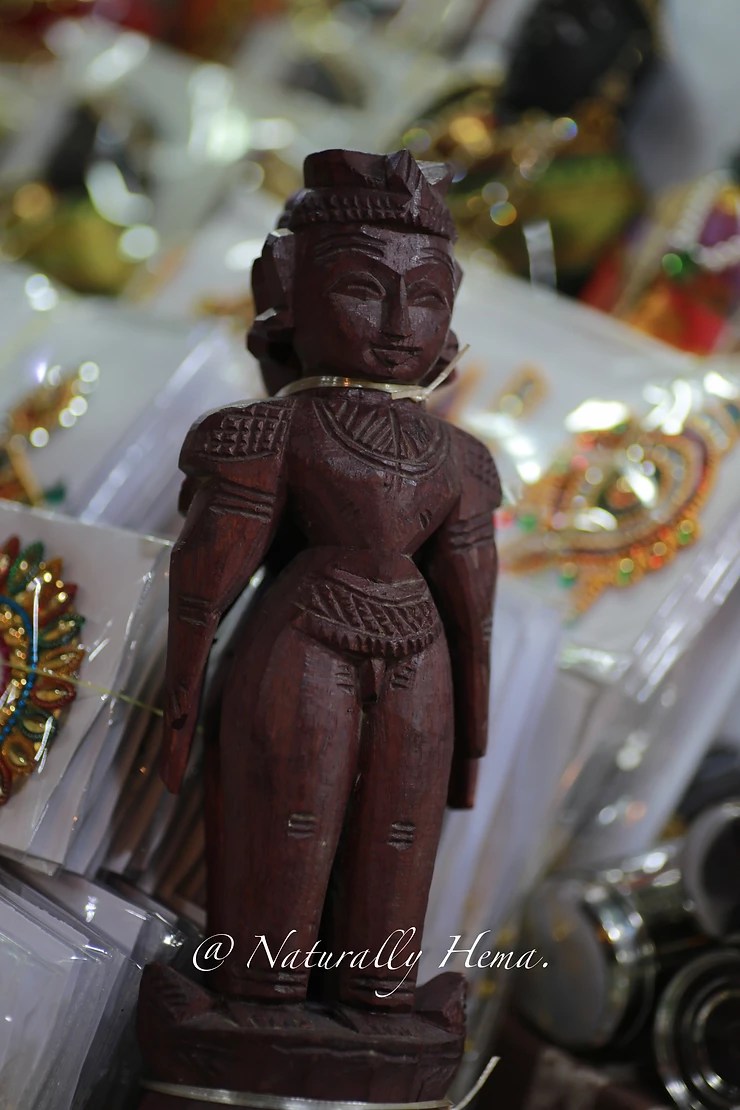
Marapachi Bommai – made from Red Sandal.
What is the Marapacchi ? Marapacchi Bommai or Rakta Bomma — Blood Red Dolls — aptly named after the red sandalwood (Adenanthera Pavonina) used to make them. Red sandalwood is what you see all along the Tirumala hills as you drive down to Tirupathi. These grow mostly in Cadappa, Tirupathi and Shesachalam districts of Andhra Pradesh. We do know this tree and many of us have seen the seeds of the tree too. The seeds of this tree are called circassian seeds. We would have seen them in temples, or in our houses. Also called manjadi seeds, here is a picture of the most beautiful natural seed on earth.
Red Sander or Sandalwood is known for its medicinal properties. Though this wood does not have any aroma like the real sandal is a great antiseptic when rubbed on wounds. Chemical infested ‘Fair and Lovely’ would not stand a chance in front of its anti-aging,skin lightening, soothing, and toning properties. The price of a real red Sandalwood is upto a Rs. 2 Lakhs per Kg in our Indian market, but they fetch a whopping Rs. 7 to Rs. 8 lakh in the chinese markets and hence a great underground market exists and a whole lot of smugglers. We all know one of our own -Verrappan who contributed his bit to the smuggling of these sanders, to the extent that the tree is on the endangered species list of flora protected under convention of International trade.

The Marapachi dolls are always made in pairs with flat heads and few basic engravings to identify a man and a women. The pair is gifted to a women on her day of marriage either as new pieces or passed on from one generation to another. It was also used as medicine for cuts — they would hold the doll by the foot and rub its head to the grinding stone to make a paste which you would then apply on the wound. Sadly, today these dolls are mostly made of Neem wood, and used more as a token of the lost heritage. But a Marapachi Bommai remains a very important part of a Bommai Kolu.

Now on the rules of the game. A Bhommai Golu cannot start with one step of dolls. Three to begin with, then five, seven, etc. Always odd numbers. Get a new doll every year, or you have sinned, says the granny next door. ‘You did buy Lakshmi and Saraswathi, Not just Durga doll right ?’ asked my aunt on the phone. But this festival of dolls seems to have emerged for some practical reasons. In the olden days, river beds would accumulate a lot of clay and obstruct the water from channeling to the fields. As the clay was removed, a tradition was created to make use of the clay. Dolls to play, dolls to pray, and dolls to showcase and accumulate for the next generation.
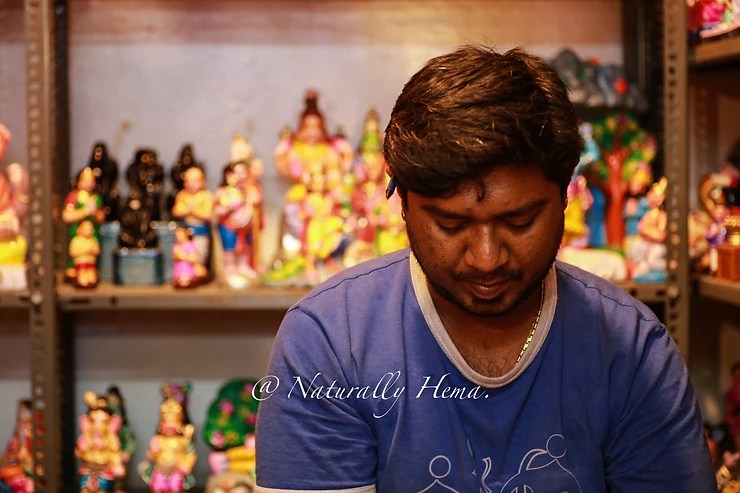
Gopi – A Dussehera doll vendor for the past 25 years.
Gopi at Jayanagar 4th block has been in the Golu business for the past fourty years,handed over to him from his father. He procures the dolls for the year from the artists. He orders the dolls five months months prior to the festival from the makers. The main artist creates the mould and then his assistants replicate them in thousands, after which they are baked ina klin. They are then left to dry in the sun for a week before the final round of artists start painting them and bringing them alive.

Dussehra to me is not just a festival of Dolls and Gods. It is a celebration of the all powerful womanhood — Shakti. She the powerful, the wise and the source of life and destroyer of evil. Each of us I believe is an incarnation of all these powers in one form or the other. This festival reminds us to fight the demons within us and become a better, stronger person. Happy Dussehra, everyone.
 Naturally Hema