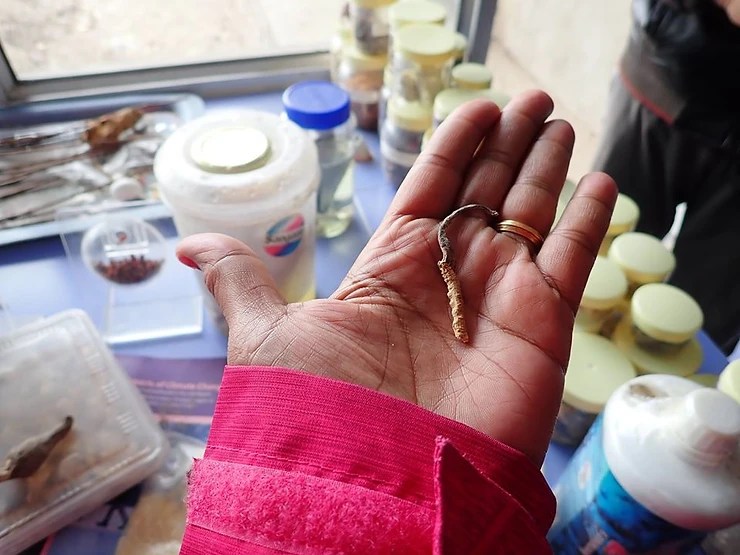
Cordyceps sinensis — also known as caterpillar fungus, or by its better-known names yartsa gunbu and keeda jadi — is found across the Garhwal and Kumaon regions of Uttarakhand. My first encounter with it was during my Roop Kund trek in 2017. My guide mentioned it in passing and showed me a dried, half-mature keeda jadi he had spotted along the trail. The story of how it forms stayed with me.
As the name suggests, keeda jadi is a fungus that grows on insects. It is found mainly in the meadows above 3,500 metres in the Himalayan regions of Nepal, Bhutan, India and Tibet. The fungus germinates inside a living larva, kills and mummifies it, and then a dark brown, stalk-like fruiting body — a few centimetres long — emerges from the corpse and stands upright.
Pithoragarh, in Uttarakhand, is where it is found in the greatest quantity. Keeda jadi sells for almost ₹10 lakh per kilogram, making it a livelihood for many villagers.
During my Zanskar trek in 2019, I stumbled upon a bottle holding a single sample of it in a small science laboratory next to where we were waiting for our bus. My curiosity cleared every hurdle, and I started chatting with the man inside. I surprised myself with how many medicinal plants I could actually identify. Impressed — with myself, and with the man, who was now convinced I worked in the forest department — I walked out after taking a photo of the keeda jadi as my souvenir.
Much of that staggering price comes from its reputation in traditional Tibetan and Chinese medicine, where it has long been valued as a tonic believed to boost energy, stamina and immunity. That demand sends villagers high into the meadows every summer to hand-pick it, one fragile stalk at a time.